From “Covfefe Talk” to Covid 19 January 18, 2021
Posted by lborodkin in : Ethics , add a comment
It seems almost quaint to think in terms of the self-regulating nature of the attorney profession in light of the January 6, 2021 armed insurrection on the US Capitol, and the need to de-platform the President of the United States from the major social media products, Twitter and Facebook. However, these events exposed major fault lines in the way the general public view the operation of the First Amendment. Many claimed the right to be heard on private commercial web-based social media products. In such times, who would the public trust to explain the boundaries of such legal rights? Attorneys — one would hope.
In March 2019, I presented a Continuing Legal Education panel at the SxSW festival with Hanna Shafran on social media ethics for lawyers. Entitled “Covfefe Talk: Social Media Ethics Rules for 2019,” (audio replay can be found here), Hanna and I ran through a number of ethics scenarios presented by attorneys’ use of various forms of social media. In 2019, how attorneys should deal with online disinformation (TLDR for attorneys: don’t) seemed more like esoteric trivia rather than a potentially life-threatening epidemic.
Yet it has been repeatedly reported, with increasing levels of alarm, that the spread of online disinformation represents a chronic threat to the health and safety of the general public. For most of 2020, I was concerned about the spread of dangerous anti-scientific conspiracy theories with regard to Covid-19. But in early 2021, an even more shocking rupture in occurred. The failure of the three branches of the US government to operate as a check and balance on the spread of disinformation, in turn fueled the Capitol riots. The fact that Facebook and Twitter were able to do what Congress and the US Courts could not (stop the President of the United States from spouting dangerous conspiracy theories in real time) should cause every attorney in America to ask, “How did we get here?” and “How can we guard against the inevitable repetition of such events?”
The legal profession, in fact, has a number of ethics rules and procedures in place to monitor and discipline such lapses as would cause society to lose faith in the legal profession, as Hanna and I discussed at SxSw. It is the duty of the members of our profession to know and use these ethics rules in these times. The recent proceeding to disbar Rudy Guiliani will be watched closely. However, it is only a start. To paraphrase Edmund Burke, the only thing necessary for the triumph of evil is for good people to do nothing. We should start by knowing the ethics rules, applying them scrupulously, and calling in appropriate circumstances for the application of those rules to deter abuse of the public trust.
An alarming number of highly-placed members of our government with extremely sophisticated and prestigious legal training nonetheless participated in an ideological assault on our very form of democracy by objecting to the election results. They know better. As lawyers, we cannot just look the other way. It is essential to the survival of our profession that we, as lawyers, call out their wrongdoing and live these principles ourselves. Otherwise, why should the public trust us?
Social Media in the Workplace and Social Media Employment Update February 8, 2019
Posted by lborodkin in : Uncategorized , add a commentEarly 2019 and 2018 have seen rapid changes in employment law in California. The rise of social media by employers and employees in the workplace and in employment relationships creates novel issues in employment and social media law. Here are links to some presentations I have done focusing on a few issues regarding social media and employment law.
Here is video from a social media update I prepared for an audience of employers in 2018:
And here are some slides I prepared from a 2017 mid-year update on social media in the workplace:
Next up, on March 16, 2019, my fellow lawyer in the community Hanna Shafran and I will be presenting an ethics CLE at South by Southwest directed at lawyers on “Covfefe Talk: Social Media Ethics Rules for 2019.” Come say hello if you’ll be in Austin this March!
“Art of Law” with Lynn Rosenblum January 18, 2019
Posted by lborodkin in : Uncategorized , add a commentHere’s my “Art of Law” interview with Lynn Rosenblum, toy law professor and expert in toy
Lynn and I previously worked together on the Hasbro My Little Pony case discussed in this article.
Shout out and special thanks to Matthew Eisenberg Productions for production and post-production services. Enjoy!
This Week in Law 427: World War Gen Z, AT&T and Time Warner Merger Decision Fisking June 27, 2018
Posted by lborodkin in : Uncategorized , add a commentHad a great time as always guest hosting on my favorite law netcast, This Week in Law, with Denise Howell and J. Michael Keyes, on June 22, 2018. Glad I could discuss Deep Fakes, “Gen Z” (persons between 13 and 23), Hamilton, ticket-buying bots, the Music Modernization Act and more.
What was yesterday’s “Mergers of Dystopia” (This Week in Law 247, February 21, 2014) is today’s At&T-Time Warner Merger, plus bonus California Net Neutrality Bill dilution.
Watch the replay here:
This Week in Law 427 with Denise Howell, Mike Keyes and Lisa Borodkin “World War Gen Z”
Oh, and p.s. don’t call it Velcro. It’s “hook and loop.”
Navigating the YouTube Safe Harbor: One Year Later (or Netflix Not Chill) February 23, 2018
Posted by lborodkin in : Uncategorized , add a commentOne year after presenting “Navigating the YouTube Safe Harbor” at the 2017 SxSW 2017 Music Festival with Kelly Klaus, John Tehranian and David Schelzel, I find that the SxSW organizers have posted audio from our presentation on SoundCloud.
(Thanks, SxSW!)
Cut to 2018. Former disrupters Netflix and Amazon Studios have aligned themselves with traditional Big Content to sue the makers of Dragon Box and Tick Box for their online streaming devices. The complaints rely in part on the marketing language used by the defendants.
On February 13, 2018, Tickbox stipulated to a preliminary injunction where they agreed to (among other things), not include, provide links to, curate, or create add-ons or otherwise technologically enable third-party cyberlockers or streaming sites that Tick Box knows or has reason to know transmits pirated content. (Internet Explorer, Google Chrome, Safari, and Firefox are not defined as such transmitters).
The Dragon Box is at an earlier stage, with no preliminary injunction application filed and no response due until March 5, 2018. Dragon Box’s attorney had some interesting quotes in Ars Technica on the stakes raised by this case, if it does not go the plaintiffs’ way.
Netflix and chill, this is not.
This Week in Law 364 “Masks, Hats, & Hoodies” October 21, 2016
Posted by lborodkin in : Uncategorized , add a commentHad a great time guesting on This Week in Law 364 with Denise Howell and Emory Roane. We talked about warrants for fingerprints (2 thumbs, 8 fingers down), facial recognition technology chilling effects, anti-surveillance, anti-drone camouflage fashion, the “Encryption Commission,” and much more.
We talked about the ethics and morality of smart cars and AI, which of course brought up the smart car scene in Hot Tub Time Machine 2:
On the note of dystopian surveillance fashion, Chanel showed in Paris a brilliant read-to-wear show for Spring 2017 with a futuristic surveillance, server farm theme. Check it out:
Finally, a small plug for our South By Southwest 2017 panel, Navigating the Youtube Safe Harbor with John Tehranian of One LLP and Kelly Klaus of Munger, Tolles and Olsen. See you in Austin, I hope.
Yes, Bad Publicity: FTC to Crack Down on Celebrity Endorsements August 7, 2016
Posted by lborodkin in : Uncategorized , add a comment
Both Bloomberg and Marie Claire broke stories last Friday that the FTC is going to pursue investigation of celebrity endorsements that aren’t clearly advertisements.
The announcement is the continuation of the FTC getting tougher with entertainment-based companies that do not clearly follow FTC Guidelines such as the proposed consent order in the Warner Bros. settlement with the FTC over “Middle Earth: Shadow of Mordor” game influencers with influencers such as YouTube star PewDiePie.
This blog previously reported the “Pony Stars” Disney’s $3 million consent judgment with the FTC over alleged violations of the Children’s Online Privacy Protection Act by collecting the data of thousands of children under age 13 without parental consent.
The FTC‘s interest in extending regulatory probes into the music, gaming and children’s entertainment industries is the writing on the wall that players in those industries need to rethink the old Hollywood adage “There’s no such thing as bad publicity.” If the publicity is paid for, you better tell the public who paid and how much, or else face FTC scrutiny.
On a somewhat related note, more ideas about “How to Act as a Business in a World in Which User Feedback and Reviews Are Critical to Your Reputation and Business” can be found in the presentation that Bennett Kelly and I did for the 12th Annual Stanford 2015 E-Commerce Best Practices Conference presentation on June 8, 2015 with Laurence Wilson of Yelp, Ed Chansky of Greenberg Traurig and attorney Francine Ward.
Slides of the Stanford presentation below:
(Photo Credit: Ted Murphy under Creative Commons license via flickr) Shoutout to my old BlogWorld 2009 panelists on “Sponsored Conversations” Ted Murphy, Jeremiah Owyang, Jennifer Leggio and Wendy Piersall.
This Week in Law Episode 247: Mergers of Dystopia July 2, 2014
Posted by lborodkin in : Uncategorized , 1 comment so farThe big media mergers just keep on coming. AT&T wants to acquire DirectTV, Comcast is ready to gobble up Time Warner, and Sprint is finalizing its merger with T-Mobile.
Antitrust Professor Spencer Waller, FCC watchdog Ryan Radia, and I discussed such mergers with Evan Brown on This Week in Law 247, “Mergers of Dystopia.” Here’s the video:
Dumb Starbucks in Los Feliz February 12, 2014
Posted by lborodkin in : Uncategorized , add a commentA Dumb Starbucks opened in my neighborhood over the weekend.
The Guardian asked me to write an op-ed piece on it, so I did.
“Dumb Starbucks was the perfect crime, but Starbucks was smart to play dumb.”
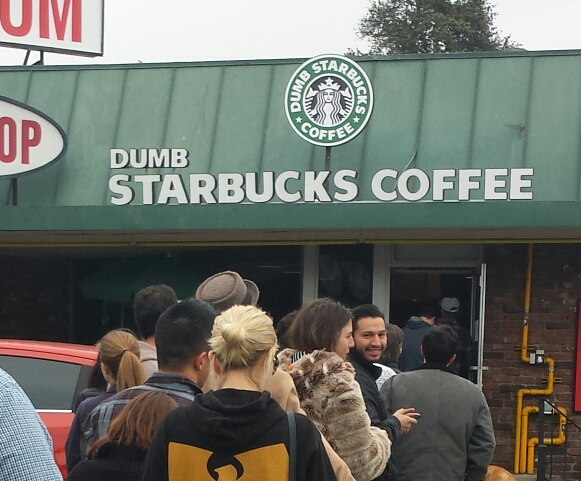
Dumb Starbucks at 9:30 a.m. on Sunday, February 9, 2014. Photo: (c) Lisa Borodkin
A casual poll of my Los Feliz friends yielded a generally positive range of reactions. The stunt was funny, and timely. I had just attended a Digital LA panel on the future of Silicon Beach and Hollywood. In a world where there is a demonstrated consumer demand to skip through televison commercials (see Fox Broad. Co. v. Dish Network L.L.C., 2014 U.S. App. LEXIS 1657, 2014 WL 260572 (9th Cir. Cal. Jan. 24, 2014), a/k/a the “Dish Hopper” case), what is the future of the television commercial? I hope this is it.
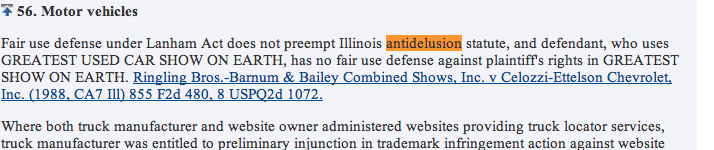
I did find a funny typo in LEXIS misspelling Illinois’ anti-dilution statute as “antidelusion.” If only states could eliminate delusions so easily.
The only thing diluted by Dumb Starbucks was the coffee.
Anyway, the whole thing was a lot of fun, and I look forward to more terrible advice from Nathan and doomed retail establishments next to my dry cleaner.
Nathan Fielder says he’s going to open a Dumb Starbucks in Brooklyn next week. Let’s just hope it’s in Williamsburg.
This Week in Law Episode 243: OKScraping, Mugshot sites, and Big Content Watches You February 7, 2014
Posted by lborodkin in : Uncategorized , add a commentWe had a lot of fun recording Episode 243 of This Week in Law webcast with Denise Howell and Evan Brown. Among other stories in our rundown, I found the one about the lonesome computer programmer who “hacked” OKcupid.com to find his girlfriend particularly charming. No, I don’t think he violated the Computer Fraud and Abuse Act, but it’s fun to think about.
It’s also fun to think about the future of Bitcoin, which we also discussed. The two economists who appeared as the guests on This Week in Law 244 (Stan Liebowitz, James Miller) opined that Bitcoin is essentially a shell game until the regulators catch up with it.
But with insider traders like Mathew Martoma sucking value out of the regulated markets $245 million at a time, is it irrational to put one’s trust in those developing the Bitcoin protocol? There is no inherent connection to illegal activity. Transactions would be totally traceable in metadata, unlike with cash, as long as the transactions stay within the US.
Seems more like the bad risks driving out the good, if you view the financial markets as risk pools. We now have other options. I’d accept Bitcoin for services. Would you?





 del.icio.us
 digg
digg flickr
 LinkedIn
 Technorati
 Twitter
 YouTube